Login and account-access issues feel urgent when customers believe they are locked out of money, statements, cards, or transfers.
Verification, payments, trust signals
How fintech teams can detect trust-breaking issues hidden inside customer reviews
CxPlus AI helps fintech and banking teams analyse reviews, support tickets, app feedback, and customer comments to identify recurring complaints, customer sentiment shifts, trust concerns, and actionable product feedback.
This is an illustrative example showing how CxPlus AI can help teams analyse customer feedback. It is not based on a specific customer engagement.
identity verification failureslogin issuespayment delaysaccount restrictionssupport delaystrust and security concerns
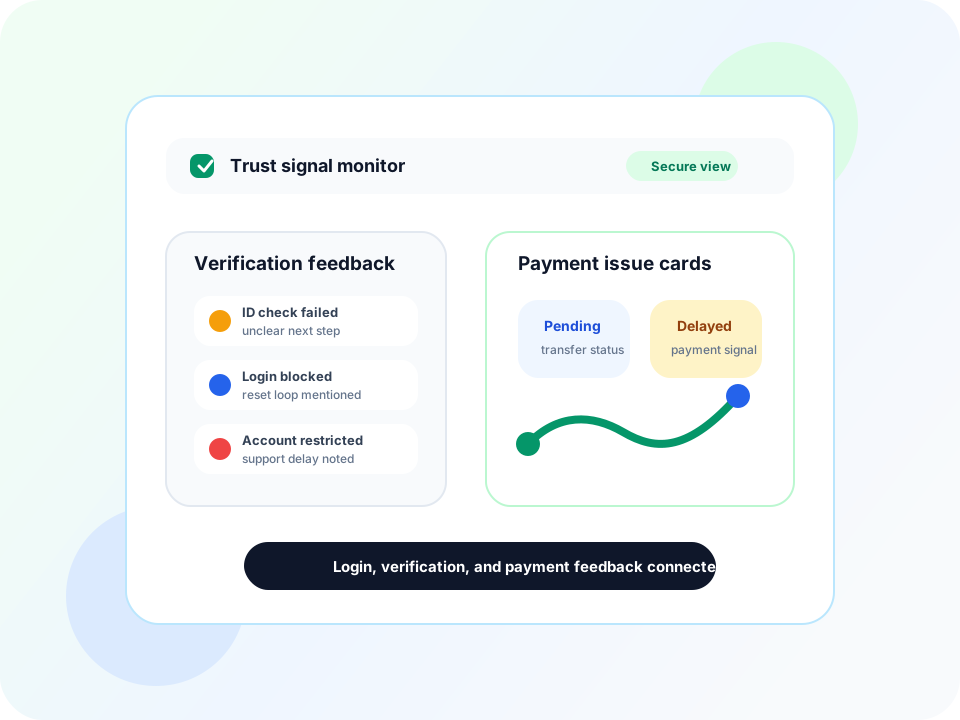
Access, money movement, and trust
In fintech, access problems become trust problems quickly.
A customer cannot log in before moving money. Another fails identity verification without knowing what to do next. A third sees a transfer marked as pending and cannot get a clear support response.
In another category, that might be a usability issue. In fintech, the complaint quickly becomes about control, safety, confidence, and whether the product can be trusted with money.
Trust, access, and verification
See when login, verification, payment, and support issues become trust issues.
CxPlus AI helps teams inspect whether customers are describing inconvenience, blocked access, unclear financial status, or anxiety around money movement.
Verification loops get worse when the next step is unclear: upload again, wait, contact support, or complete a policy review.
Pending transfers become trust complaints when status language is vague, inconsistent, or too slow to reassure customers.
Blocked accounts and unclear support responses can move from private tickets into public reviews about safety, reliability, and control.
Keep trust-sensitive complaints from blending into ordinary app feedback.
CxPlus AI helps teams see whether customer anxiety is about product usability, money movement, identity checks, account restrictions, or response clarity.
Login and verification loops
Identity checks, failed verification, password resets, and blocked login journeys can be grouped into one access-friction view.
Payment delays and account access
Payment delays, account restrictions, and transfer concerns can be tracked together instead of treated as scattered one-off messages.
Trust language in customer reviews
Language around safety, reliability, and access can be kept visible instead of buried inside broad app feedback.
Support tickets beside app reviews
Private support tickets and public app reviews can be compared when access or payment issues start appearing in both places.
Themes that are getting louder
Verification failures, support delays, and payment complaints can be checked over time to see what is gaining momentum.
Follow-up questions before escalation
Teams can ask what customers are saying about account restrictions, failed payments, onboarding, or security reassurance.
Access and transfer readout
Example: pending transfers after failed verification
Synthetic example. It shows the shape of an insight CxPlus AI could surface, not a live customer deployment.
Theme
Payment delay tied to unclear account status
What customers are saying
Customers say transfers are pending, verification failed, login attempts are blocked, and support replies do not explain what happens next.
Pattern detected
The highest-anxiety reviews combine money movement language with uncertainty around identity verification or account restrictions.
Likely operational/product question
Are customers frustrated by the delay itself, or by not knowing whether the delay is verification, policy, bank processing, or support backlog?
Teams involved
ProductCustomer SupportRisk operationsVoice of Customer
Suggested next step
Compare payment-delay complaints by transfer type, verification state, support response timing, and public review language.
Trust questions worth investigating
Ask where the customer lost confidence.
Fintech feedback is useful when teams can see whether the complaint is about access, status, money movement, or unclear next steps.
Are verification complaints about failure itself or unclear next steps?
Are payment-delay complaints tied to specific transfer types?
Are account restriction complaints increasing after a product or policy change?
Which support delays are most likely to become public trust complaints?
Trust-sensitive feedback workspace
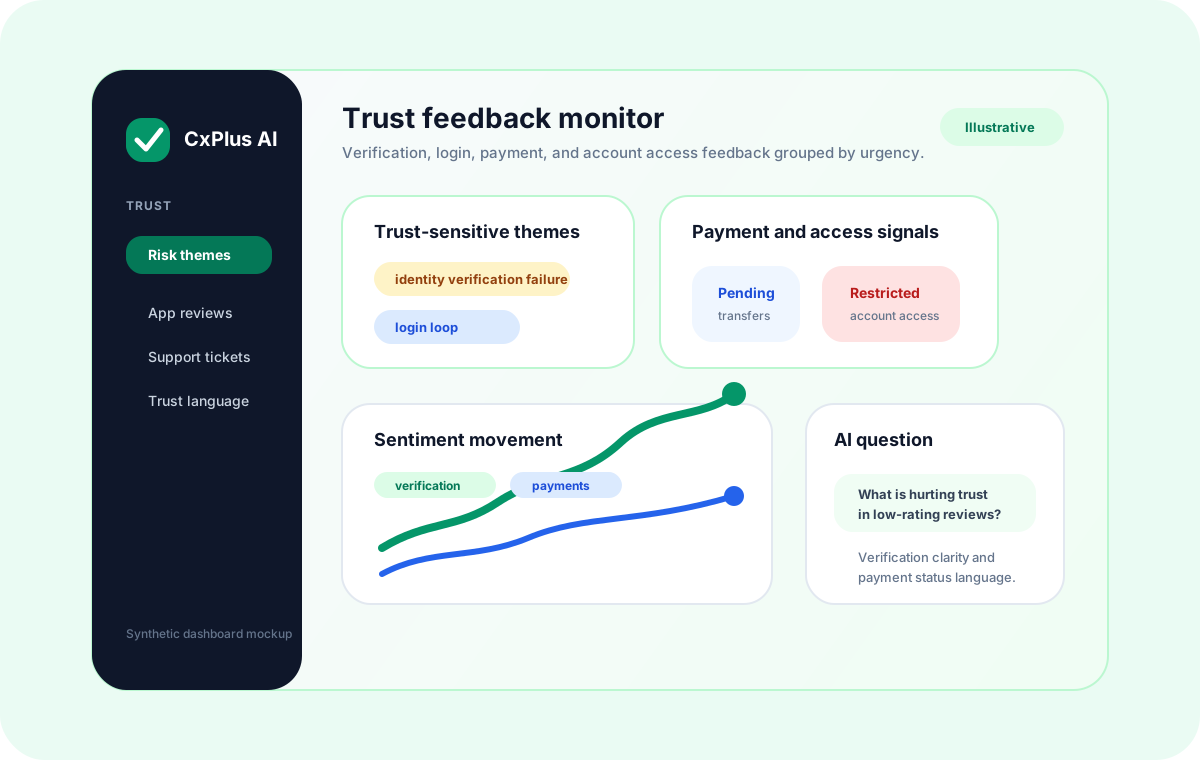
A dashboard view for trust-sensitive app feedback
This synthetic dashboard shows how fintech feedback could be separated into verification, payment, account access, and support themes so teams can inspect trust-breaking issues earlier.
Illustrative product UI mockup. The labels and themes are synthetic and are not customer data.
Trust patterns to inspect
Where access anxiety starts to show up in review language.
These examples show the kind of analysis the product is designed to support. They are illustrative, qualitative examples rather than measured outcomes from a named organisation.
1
Verification trust friction
Customers mentioning account verification are more likely to leave low-rating reviews and frequently mention unclear next steps.
2
Payment status confusion
Payment delay complaints appear concentrated around transfers marked as pending without enough status explanation.
3
Login access escalation
Login issues are frequently mentioned alongside support delays, suggesting access problems may feel worse when help is slow.
Where this helps fintech teams
Use it when app reviews mix login failure, verification loops, pending transfers, blocked accounts, and support uncertainty.
For fintech and banking teams, CxPlus AI can help improve visibility into trust-sensitive customer feedback, prioritise recurring product friction, reduce manual review analysis, and align product, risk, and support teams around the issues customers are already describing.
Best fit
- verification complaints and unclear next steps
- login and account-access issues
- payment-delay and pending-transfer frustration
- negative app reviews with trust-sensitive language
- support responses that leave customers anxious about money
Not a replacement for
- fraud detection
- regulatory compliance automation
- replacing KYC or risk systems
- financial transaction monitoring
Follow the trust signal
Bring access, verification, and support clarity into the same conversation.
Voice of Customer and insights
Trust-sensitive complaints need the customer language preserved, not flattened into a generic product issue.
Customer Support teams
Unclear support responses around access, verification, and payment status can turn private tickets into public trust complaints.
Product Managers
Login, verification, and status-explanation friction can become product priorities when they repeatedly affect customer confidence.
Explore more
Other illustrative use cases
Food delivery
Food delivery / marketplace apps
See how food delivery teams can analyse late orders, missing items, refund delays, driver cancellations, app crashes, and support pressure with CxPlus AI.
Ecommerce
Ecommerce / DTC brands
See how ecommerce and DTC teams can analyse delivery delays, returns friction, sizing or fit complaints, damaged items, refund confusion, and repeat purchase risk.
SaaS
SaaS / B2B software
See how SaaS teams can analyse onboarding friction, integration gaps, admin permissions, confusing workflows, repeated tickets, workarounds, and churn-warning feedback.
Healthcare booking
Healthcare / booking platforms
See how healthcare booking platforms can analyse appointment availability, cancellations, rescheduling, reminder failures, clinic communication, and trust in care access.
Fintech review analysis
See how trust-sensitive app reviews can be separated from ordinary product feedback.
Use a review export, support-ticket sample, or synthetic walkthrough to inspect access, verification, payment-delay, account-restriction, and support-response themes.